
“Go Down Moses” is more than a religious song. Its spiritual meaning is closely tied to freedom, justice, hope, and the courage to resist oppression.
For Americans, the song also carries deep connections to African American history. Its biblical story became a powerful way to express longing for liberation under slavery and later struggles for equality.
The song draws from the Book of Exodus, where Moses is commanded to confront Pharaoh and demand freedom for the Israelites. Over time, that story became meaningful far beyond its original biblical setting.
Today, “Go Down Moses” can represent breaking away from oppression, finding strength during hardship, and believing that freedom is possible. Its meaning can be religious, historical, cultural, or deeply personal.
Quick Answer
Go Down Moses Spiritual Meaning: Freedom centers on liberation from oppression and the hope of reaching a freer life. In the United States, it is especially connected with African American spiritual traditions and the history of slavery, while its broader biblical meaning concerns deliverance, justice, faith, and courage.
TL;DR
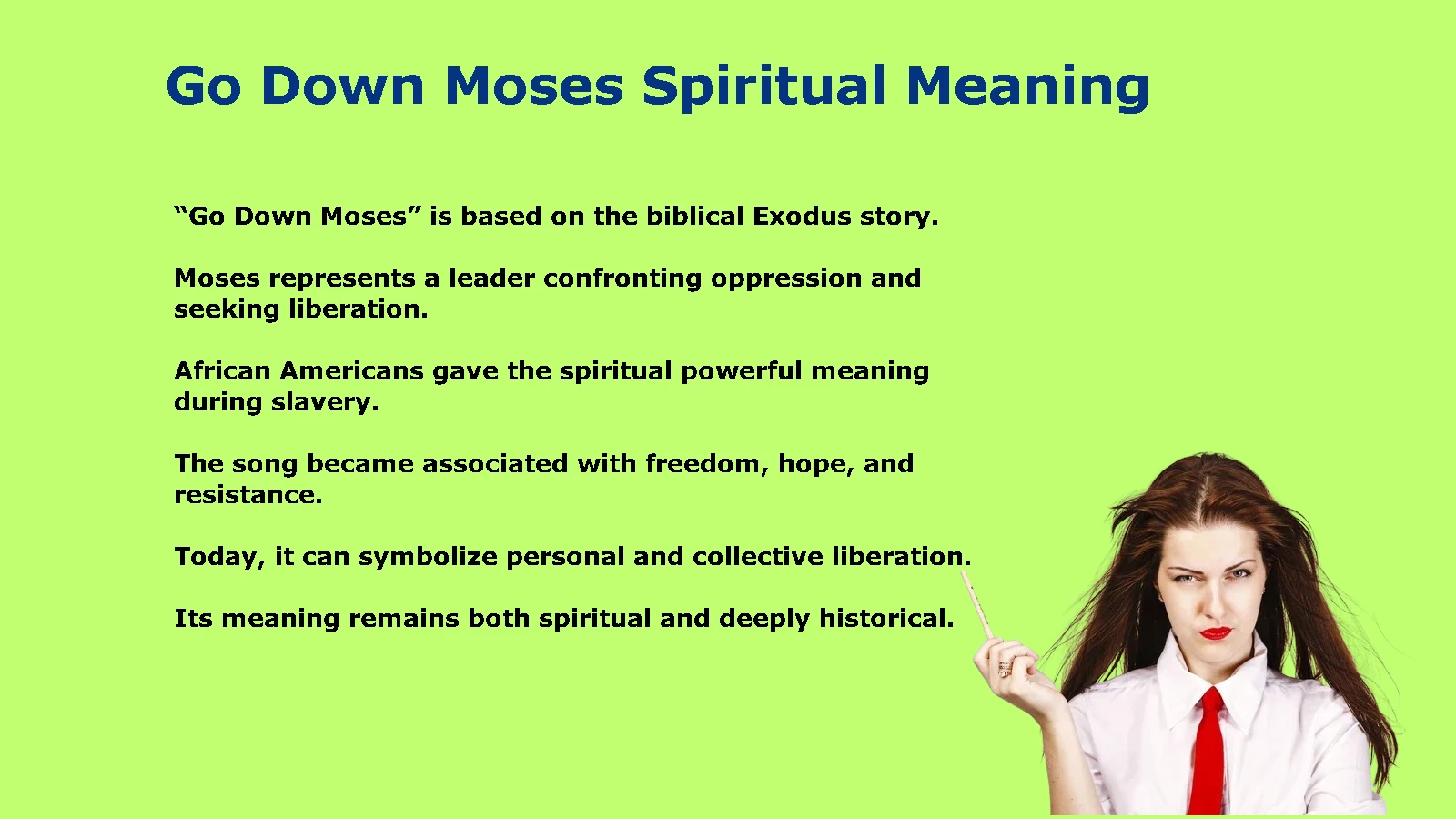
- “Go Down Moses” is based on the biblical Exodus story.
- Moses represents a leader confronting oppression and seeking liberation.
- African Americans gave the spiritual powerful meaning during slavery.
- The song became associated with freedom, hope, and resistance.
- Today, it can symbolize personal and collective liberation.
- Its meaning remains both spiritual and deeply historical.
What Is the Meaning of Go Down Moses?
The song tells the story of Moses confronting Pharaoh on behalf of an oppressed people. Its central message is a demand for freedom rather than passive acceptance of suffering.
For American readers, however, the song has another important layer. African American communities transformed biblical language into spiritual expression during an era of slavery and extreme oppression.
The Central Message
The song’s famous command, “Let my people go,” captures its strongest idea: liberation.
Moses isn’t simply a biblical character in this context. He becomes an image of courage, leadership, resistance, and deliverance.
The song can therefore suggest:
- Freedom from physical oppression
- Hope during prolonged hardship
- Resistance against unjust authority
- Faith in eventual deliverance
- Courage to seek a better future
Biblical Origins of Go Down Moses
The roots of “Go Down Moses” come from the Book of Exodus in the Hebrew Bible and Christian Old Testament. The story describes the Israelites living under Egyptian oppression.
God calls Moses to confront Pharaoh and demand that the Israelites be released. Pharaoh initially refuses, leading to a series of events that eventually result in the Israelites leaving Egypt.
Moses and Pharaoh
The relationship between Moses and Pharaoh gives the song its dramatic tension.
Moses represents a person carrying a message of liberation. Pharaoh represents a powerful ruler who refuses to surrender control.
This contrast helps explain why the song became such a strong symbol of freedom. The story presents liberation as a confrontation with an unjust power structure.
The Exodus as a Symbol
The Exodus story has influenced religious thought for thousands of years.
It is commonly associated with:
- Deliverance from bondage
- A journey toward freedom
- Divine justice
- Leadership during crisis
- Hope after suffering
The song draws much of its emotional force from this older biblical pattern.
African American Spiritual Meaning of Go Down Moses
The song’s American history is essential to understanding its deeper meaning. “Go Down Moses” belongs to the tradition of African American spirituals that developed among enslaved Black communities.
These songs often drew from biblical stories while expressing the realities of life under slavery. Biblical language could carry meanings that reached beyond worship and into everyday experiences of suffering, hope, community, and freedom.
Biblical Stories and Enslavement
The Exodus story had obvious emotional power for enslaved African Americans.
A people held in bondage could identify strongly with the Israelites seeking freedom from Egypt. Moses could therefore become an image of liberation and divine justice.
However, spirituals shouldn’t be reduced to hidden messages alone. They were also religious expressions, cultural creations, and ways communities preserved hope under brutal conditions.
Harriet Tubman and the Song
“Go Down Moses” is also strongly associated with Harriet Tubman in American historical memory.
Tubman escaped slavery and later helped other enslaved people reach freedom through the Underground Railroad. Accounts and later traditions connect her with spirituals, including songs understood as carrying messages within freedom-seeking networks.
The exact historical use of particular songs can be difficult to establish. Still, the association between Tubman, Moses, and liberation remains powerful in American culture.
What Does Go Down Moses Symbolize in America?
In the United States, “Go Down Moses” carries meanings shaped by religion, slavery, emancipation, civil rights, and African American cultural history.
Its symbolism therefore extends beyond the biblical story. For many Americans, it represents the long struggle to move from bondage toward freedom.
American Associations
| Context | Meaning in the USA | Common Associations | Notes |
| African American spirituals | Hope and liberation | Faith, survival, community | Rooted in Black religious culture |
| Biblical Exodus | Deliverance | Moses, Pharaoh, freedom | Provides the song’s central story |
| Slavery era | Longing for freedom | Resistance, escape, endurance | Meaning developed within oppression |
| Civil rights era | Equality and justice | Protest, dignity, liberation | Biblical freedom imagery remained influential |
| Modern culture | Personal liberation | Strength, change, renewal | Meaning can be religious or secular |
The song’s American meaning is especially powerful because freedom is a central theme in the nation’s history.
At the same time, American history contains a painful contradiction. The language of liberty existed alongside centuries of legalized slavery and racial inequality.
“Go Down Moses” sits directly within that tension.
The Spiritual Meaning of Freedom
Freedom is the clearest symbolic theme in the song. Yet freedom can mean several different things depending on the listener.
For an enslaved person, freedom could mean physical escape. For a religious believer, it could also mean spiritual deliverance and trust in divine justice.
Freedom From Oppression
The song imagines oppression as something that should not continue forever.
That idea gives the song an enduring emotional force. It doesn’t present suffering as the final destination.
Instead, it points toward release.
Freedom as a Journey
The Exodus itself is a journey.
The Israelites don’t simply receive freedom and immediately enter a perfect life. They leave one condition and travel toward something unknown.
Because of this, “Go Down Moses” can symbolize the difficult process of becoming free. Change may require courage, uncertainty, patience, and collective action.
Moses as a Symbol of Leadership
Moses represents more than freedom itself. He also represents the person willing to confront power.
His role gives the song a strong leadership theme. He receives a difficult task and must challenge Pharaoh despite the risks.
What Moses Can Represent
For modern readers, Moses may symbolize:
- Moral courage during difficult circumstances
- Leadership on behalf of vulnerable people
- Speaking against injustice
- Commitment to collective freedom
- Persistence despite powerful opposition
However, Moses isn’t presented as a flawless modern political figure. His significance comes from his place in the biblical story and the meanings communities have attached to him over time.
Cross-Cultural and Spiritual Meanings
The Exodus story has significance across Jewish and Christian traditions, and Moses is also an important prophet in Islam.
Jewish tradition gives the Exodus a central place in the story of Israel’s liberation from Egypt. Christianity often connects Exodus imagery with broader ideas of salvation and deliverance.
Islam also honors Moses, known as Musa, as a major prophet who confronts Pharaoh and leads his people from oppression.
A Shared Pattern
Across these traditions, the story commonly involves:
- Oppression followed by deliverance
- A leader confronting a ruler
- Faith during uncertainty
- Justice against wrongdoing
- Movement toward freedom
The song itself belongs specifically to the African American spiritual tradition. Its later interpretations should therefore be understood without erasing that cultural history.
Emotional and Psychological Meaning
“Go Down Moses” can evoke strong emotions because its story moves from oppression toward hope.
The tension between Pharaoh and Moses creates a simple but powerful emotional structure. Someone is suffering, authority refuses change, and liberation becomes the desired outcome.
Feelings the Song Can Evoke
Listeners may associate it with:
- Hope after prolonged hardship
- Courage in the face of fear
- Grief over historical suffering
- Determination to overcome barriers
- Relief connected with freedom
For some people, the song can also represent a personal turning point. Leaving a harmful situation, overcoming limitations, or beginning a new chapter may all feel like an individual Exodus.
Go Down Moses in Black American History
Understanding the song requires attention to African American history. Spirituals developed as a major form of religious and cultural expression among enslaved Black Americans.
They carried biblical themes while reflecting lived experiences of bondage, family separation, forced labor, faith, and hope.
From Slavery to Freedom
After emancipation, the symbolism of the song did not disappear.
Instead, its language could continue to speak to later struggles for dignity and equality. The Exodus remained a useful image for people confronting injustice.
During the civil rights era, biblical language of liberation continued to influence African American religious and political expression.
Why the History Still Matters
Modern listeners sometimes encounter the song without knowing its historical background.
That can make its words seem like a simple religious reference. Yet its American history gives the song additional emotional depth.
The same biblical story became part of a distinctly African American experience.
Modern Uses of Go Down Moses
Today, “Go Down Moses” appears in religious settings, historical programs, concerts, educational contexts, recordings, and cultural events.
It can also appear in discussions about freedom and African American heritage.
Music and Performance
Modern performers may interpret the song as gospel, spiritual, choral music, folk music, or historical repertoire.
Different arrangements can change its emotional tone. A slow performance may emphasize sorrow and endurance, while a stronger arrangement can highlight determination and liberation.
Education and Cultural Memory
Teachers and museums may use spirituals to introduce students to African American history.
In these settings, “Go Down Moses” can help connect several subjects at once. Biblical history, American slavery, music, resistance, and cultural memory all meet within the song.
Go Down Moses Tattoos and Personal Symbolism
A person choosing “Go Down Moses” imagery for a tattoo may be expressing a strong connection to freedom.
The design doesn’t necessarily have to show Moses himself. Symbols such as broken chains, a pathway, water, or the words “Let my people go” can communicate related ideas.
Common Design Ideas
Potential imagery can include:
- Moses holding a staff
- A parted sea
- Broken chains
- A path leading toward open space
- Biblical lettering or short quotations
- Symbols of freedom and perseverance
However, context matters. Using imagery connected to African American spiritual history deserves cultural awareness and respect.
Misunderstandings and Controversies
One common misunderstanding is treating “Go Down Moses” as only an ancient biblical song.
Its American history is much more specific. The spiritual developed within African American communities and later became part of the broader cultural history of the United States.
Avoiding Oversimplification
Another mistake is assuming every spiritual had one secret meaning.
Some spirituals may have carried layered meanings, but historians often lack enough evidence to prove exactly how every song was used in every situation.
Therefore, it’s better to recognize multiple dimensions. “Go Down Moses” can be religious, historical, emotional, communal, and political in its associations.
Cultural Respect
The song should also not be separated from the suffering and creativity of the people who preserved and developed the spiritual tradition.
Using it as a generic “freedom slogan” can overlook that history. Understanding its roots makes modern use more meaningful.
How the Meaning Has Changed Over Time
The symbolism of “Go Down Moses” has never been completely fixed.
Its biblical foundation remained relatively stable, but American circumstances changed the way people heard it. During slavery, liberation had an immediate and profound meaning.
After emancipation, the song could become part of a larger cultural memory. Later generations could connect its language with civil rights, racial justice, personal freedom, or historical remembrance.
From Biblical Story to American Symbol
The progression can be understood simply:
Biblical Exodus → African American spiritual → emancipation-era memory → civil rights symbolism → modern freedom imagery
This doesn’t mean one interpretation replaced another.
Instead, layers accumulated over time. The original biblical story remained while new American meanings developed around it.
Why Go Down Moses Still Matters Today
Freedom remains a powerful idea in American culture.
People continue to use Exodus imagery when discussing injustice, personal transformation, social change, and the search for a better future.
A Symbol With Multiple Layers
For one person, the song may be primarily religious. For another, it may represent African American history or the struggle against oppression.
Someone else may hear it as a reminder that difficult circumstances can change.
That flexibility helps explain its longevity. The song offers a familiar story while leaving room for personal interpretation.
FAQs:
What does “Go Down Moses” symbolize?
“Go Down Moses” primarily symbolizes freedom from oppression and hope for deliverance. In the United States, it also carries deep African American historical and cultural meaning.
Is “Go Down Moses” an African American spiritual?
Yes. “Go Down Moses” is widely recognized as an African American spiritual rooted in the biblical Exodus story. It developed within the religious and cultural traditions of enslaved Black Americans.
What does Moses symbolize in “Go Down Moses”?
Moses can symbolize courage, leadership, resistance, and liberation. He represents someone confronting oppressive authority on behalf of an oppressed people.
Is “Go Down Moses” about slavery in America?
The song is based on the biblical Exodus, not an American slavery narrative. However, enslaved African Americans connected deeply with its story of bondage and liberation.
What does “Let my people go” mean spiritually?
Spiritually, the phrase expresses a demand for liberation from bondage. It can represent justice, deliverance, dignity, and the hope that oppression will end.
Why is “Go Down Moses” important in American history?
The spiritual became part of African American cultural memory and the broader history of freedom in the United States. Its biblical language offered a powerful framework for expressing hope and liberation.
Conclusion:
The Go Down Moses Spiritual Meaning: Freedom is rooted in the Exodus story, but its American meaning reaches much further. Through African American spiritual traditions, the song became closely connected with endurance, liberation, justice, and hope.
Today, “Go Down Moses” can remind listeners that freedom is both a historical struggle and a deeply personal idea. Whether heard as sacred music, cultural history, or a symbol of overcoming hardship, its message continues to invite reflection on courage and the journey toward a freer life.