
Spiritual Candles and Their Meaning can help explain why people light candles during prayer, meditation, personal rituals, and moments of remembrance. Across the United States, candles appear in churches, homes, memorials, meditation spaces, and spiritual practices. Their gentle light often represents hope, peace, faith, love, and the desire for a fresh beginning.
Today, many Americans use candles to create a calm atmosphere, mark important moments, or focus on personal intentions. Others light them as part of established religious traditions. Although these practices can share similar symbols, their beliefs and customs are not always the same.
However, a candle’s meaning depends on more than its flame. Its color, the reason it was lit, and the tradition behind it can all shape its symbolism. A white candle may represent peace or purity, while a red candle can express love, courage, or passion.
Understanding candle symbolism offers a useful way to explore personal meaning without assuming that every candle carries a universal message. The most important details are often the intention, setting, and cultural background behind the flame.
Quick Answer
Spiritual Candles and Their Meaning in the United States commonly center on hope, prayer, peace, remembrance, love, and personal intention. Different candle colors and traditions add other meanings, while many spiritual practices view the flame as a symbol of divine presence, inner awareness, or transformation.
TL;DR
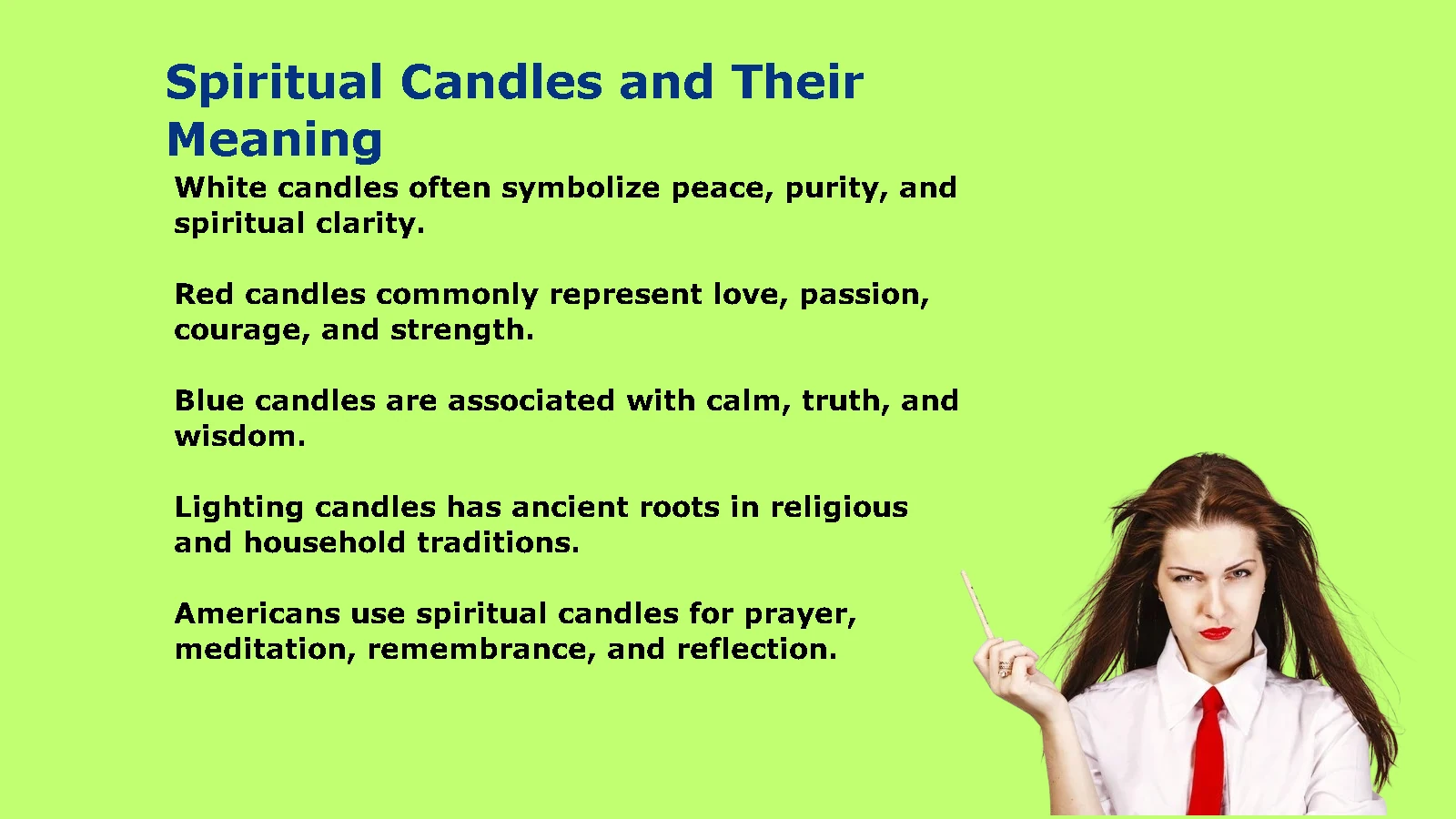
- White candles often symbolize peace, purity, and spiritual clarity.
- Red candles commonly represent love, passion, courage, and strength.
- Blue candles are associated with calm, truth, and wisdom.
- Lighting candles has ancient roots in religious and household traditions.
- Americans use spiritual candles for prayer, meditation, remembrance, and reflection.
- Candle colors carry different meanings across cultures and spiritual practices.
What Are Spiritual Candles and Their Meaning?
Spiritual candles are candles used to express faith, focus attention, or mark meaningful moments. They may be simple household candles or specially prepared candles used in religious and spiritual settings.
In the United States, their meaning often depends on personal beliefs and the purpose behind lighting them. Some people see a candle as a symbol of God’s presence, while others use its light to support mindfulness or quiet reflection.
Common Symbols Behind Spiritual Candles
A burning candle can represent several ideas:
- Light: Hope, understanding, and guidance during difficult times.
- Flame: Energy, devotion, transformation, and the spark of life.
- Wax: The physical world, change, and the passing of time.
- Wick: A central point that supports the flame and its steady glow.
These meanings are symbolic rather than universal rules. A candle can also carry personal significance because of a memory, prayer, or important life event.
Why People Light Spiritual Candles
People light spiritual candles for different reasons. Some want a quiet moment before prayer, while others honor someone who has died.
Candles can also help establish a routine. For example, lighting one before meditation may signal that it’s time to slow down and focus.
Historical Origins of Spiritual Candle Symbolism
The use of fire in spiritual life began long before modern candles existed. Ancient communities used flames for warmth, protection, ceremonies, and religious offerings.
Over time, the controlled flame became a meaningful symbol in many societies. It could represent life, sacred presence, wisdom, or a connection between the human and spiritual worlds.
Ancient and Pre-Christian Roots
Ancient Egyptians, Greeks, and Romans used lamps, torches, and other forms of controlled fire in religious settings. These lights appeared in temples, household rituals, and ceremonies honoring deities or the dead.
In ancient Greece and Rome, lamps and fire could serve practical and sacred purposes. However, these practices differed across places and periods, so they shouldn’t be treated as one shared belief system.
Candles made from available waxes and fats developed in different forms over time. Before electric lighting, they also served an everyday purpose, making their use both practical and symbolic.
Candlelight in Religious History
In Christianity, candles became important in worship, prayer, and ceremonies. Their light came to represent Christ, spiritual guidance, hope, and the presence of the sacred.
Jewish traditions also use candles in meaningful settings, including Sabbath observance and Hanukkah. Meanwhile, Buddhist and Hindu communities may use lamps or candles as offerings associated with devotion, wisdom, or the removal of spiritual darkness.
These examples show that candlelight has many historical paths. Similar images of light can carry different meanings depending on the faith and ceremony involved.
Spiritual Candle Colors and Their Meanings
Color is one of the most familiar parts of modern candle symbolism. In the United States, spiritual candle guides often connect specific colors with emotions, goals, and personal intentions.
However, these associations aren’t universal. A color may mean one thing in a personal ritual and something different in a religious ceremony.
What Different Candle Colors Symbolize
White Candles: Peace and Purity
White candles commonly symbolize peace, honesty, clarity, and spiritual renewal. They may be used for prayer, remembrance, meditation, or fresh starts.
Red Candles: Love and Courage
Red is associated with passion, vitality, romantic love, and determination. People may choose it to represent confidence or emotional strength.
Blue Candles: Calm and Wisdom
Blue often represents peace, clear communication, patience, and thoughtful decisions. Its familiar connection with sky and water can also suggest emotional balance.
Green Candles: Growth and Renewal
Green is commonly connected with nature, hope, renewal, and abundance. It may represent personal growth or a desire to develop healthier habits.
Purple Candles: Spiritual Reflection
Purple can represent mystery, wisdom, dignity, and spiritual exploration. Some people choose it when reflecting on life’s deeper questions.
Yellow Candles: Joy and Clarity
Yellow is often associated with sunlight, optimism, creativity, and mental focus. It can symbolize a hopeful attitude during a period of change.
Pink Candles: Affection and Compassion
Pink commonly represents kindness, tenderness, friendship, and gentle love. It may symbolize self-acceptance or stronger emotional connections.
Black Candles: Boundaries and Release
In some contemporary spiritual practices, black represents protection, endings, and letting go. In other settings, it may symbolize mourning, formality, or solemn reflection.
Do Candle Colors Have Fixed Spiritual Meanings?
No single color chart applies to every spiritual tradition. Modern candle practices often use flexible associations that vary by practitioner, culture, and intention.
For example, white may symbolize purity in one setting and mourning in another. Therefore, it’s helpful to consider the candle’s religious background before interpreting its color.
Spiritual Candles and Their Meaning in American Culture
In the United States, spiritual candles appear in both religious and nonreligious settings. Their symbolism reflects the country’s varied faith communities, family traditions, and growing interest in personal reflection.
For many Americans, a candle can connect a private feeling with a visible act. Its light provides a simple way to express something that may be difficult to put into words.
Candles in American Religious Life
Churches across the country use candles during worship, prayer, baptisms, weddings, and funerals. Catholic and Orthodox Christians may light votive candles as part of personal devotion.
Jewish American families light candles for Sabbath observance and other sacred occasions. Meanwhile, other religious communities use candles or lamps according to their own customs.
These practices share the use of light but don’t necessarily share the same theology. Each tradition gives its candles meaning within a larger set of beliefs.
Candles in Everyday American Life
Outside formal worship, candles are common at memorials, vigils, meditation sessions, and personal ceremonies. People may light them after a tragedy to honor victims or express solidarity.
Candles also appear during birthdays, weddings, holidays, and moments of personal change. Although some uses are spiritual, others are primarily emotional or cultural.
Common American Associations
- Hope: A small light during a painful or uncertain time.
- Remembrance: A visible tribute to someone who has died.
- Faith: An expression of prayer or religious devotion.
- Peace: A quiet atmosphere for reflection and stillness.
- Community: Shared light during vigils and public ceremonies.
Spiritual Candle Meanings Across Religions and Cultures
Candles and other lights appear in many religious traditions around the world. Their meanings can overlap, but it’s important to understand each practice in its own context.
For American readers, this distinction matters because similar rituals don’t always express identical beliefs.
Christianity and Candlelight
Many Christian communities connect candlelight with Christ, hope, prayer, and spiritual guidance. Candles may be placed near altars, religious images, or memorial displays.
During Advent, some churches light candles over several weeks in preparation for Christmas. An Easter candle can represent the resurrection and the victory of light over darkness.
Judaism and Sacred Light
Candles have important roles in Jewish life. Families commonly light Sabbath candles, while Hanukkah celebrates the rededication of the Second Temple through a distinctive eight-night festival involving the lighting of lights.
Memorial candles may also honor deceased relatives. The specific practice and its meaning depend on the occasion and Jewish tradition.
Hinduism and Buddhism
In Hindu traditions, lamps and other lights may be offered during worship as expressions of devotion. During Diwali, lights are widely associated with the triumph of light over darkness, although the festival’s meanings vary across communities.
In some Buddhist settings, candles or lamps represent wisdom, awareness, and the overcoming of ignorance. Practices differ between Buddhist schools and local cultures.
Folk and Contemporary Spiritual Practices
Some contemporary spiritual practitioners use candle colors, written intentions, or carefully arranged objects during personal rituals. Certain folk traditions also incorporate candles into prayers or ceremonies.
However, no single method represents all folk spirituality. Readers should approach unfamiliar practices with respect and avoid treating sacred customs as simple decorations.
The Spiritual Meaning of a Candle Flame
The flame itself is often more important than the candle’s color. Its movement, brightness, and steady glow can provide images for reflection, although physical conditions explain many changes in how a flame behaves.
In spiritual settings, people sometimes interpret the flame as a symbol of energy, faith, awareness, or change. These interpretations are personal or tradition-based, not proven predictions of future events.
A Steady Flame
A steady flame may symbolize peace, commitment, patience, or a sense of inner balance. Its quiet appearance can remind someone to remain focused during prayer or meditation.
However, a steady flame doesn’t prove that a prayer has been answered. It may simply reflect a wick and candle burning under stable conditions.
A Flickering Flame
A flickering flame can suggest movement, uncertainty, emotional change, or the shifting nature of life. Some spiritual practitioners give it personal meaning during a ritual.
In ordinary circumstances, drafts, wick length, and airflow often explain flickering. Therefore, it’s best not to assume that every movement carries a supernatural message.
A Bright or Weak Flame
A bright flame may symbolize hope, vitality, or renewed motivation. A weak flame might prompt reflection on tiredness, patience, or the need for rest.
These are possible symbolic interpretations rather than universal signs. Candle quality, airflow, and wick condition can also affect the flame’s appearance.
The Spiritual Meaning of Lighting a Candle
Lighting a candle can turn an ordinary moment into a meaningful ritual. In American homes, it may mark the beginning of prayer, meditation, remembrance, or quiet reflection.
The action matters because it gives a person’s intention a visible form. Rather than relying only on thoughts, someone can connect an idea with a simple, repeated practice.
Lighting a Candle for Prayer
Some people light candles while asking for guidance, expressing gratitude, or praying for loved ones. In established religious traditions, the practice may carry specific meanings and customs.
A candle doesn’t need to represent a request. It can also symbolize devotion, gratitude, or the desire to remain mindful.
Lighting a Candle for Intention Setting
In contemporary spiritual practice, an intention is a purpose someone chooses to focus on. A person might light a candle before journaling about forgiveness, courage, or a new beginning.
The candle serves as a reminder of that purpose. It doesn’t guarantee a particular result, but the ritual can help someone give attention to a personal goal.
Lighting a Candle for Remembrance
People often light candles to honor loved ones who have died. The light can represent an enduring memory, continuing love, or the wish to keep someone’s influence alive.
Public vigils also use candles to express grief and solidarity. In these settings, the shared glow can help people feel connected during a difficult experience.
The Spiritual Meaning of Candle Wax and Shape
A candle’s physical form can add another layer of symbolism. Its wax, wick, container, and shape may reflect a tradition, a personal preference, or the purpose of a ceremony.
However, these details don’t have one fixed spiritual interpretation. Their meaning depends on how the candle is used.
Wax as a Symbol of Change
Wax melts as a candle burns, gradually changing its original shape. Symbolically, this process can represent impermanence, sacrifice, transformation, or the passing of time.
For some people, a melting candle is a reminder that change is part of life. In religious settings, the candle’s gradual consumption may also represent devotion or an offering.
Candle Shapes and Their Associations
Different shapes can carry visual meanings:
- Pillar candles: Stability, endurance, and sustained reflection.
- Taper candles: Ceremony, elegance, and focused attention.
- Round candles: Wholeness, unity, and continuity.
- Heart-shaped candles: Love, affection, and emotional connection.
- Star-shaped candles: Hope, inspiration, and guidance.
These associations are modern interpretive examples rather than established meanings shared by every tradition. A particular shape may also be chosen simply for its beauty or practicality.
Containers and Candle Placement
Glass containers can suggest protection, while decorative holders may connect a candle to a family tradition or sacred space. An altar candle’s placement can be more important than its shape.
For example, a candle placed beside a photograph may honor someone who has died. The same candle on a dinner table might simply create a welcoming atmosphere.
Spiritual Candle Meanings by Purpose
The purpose behind a candle often gives it more meaning than its appearance. In the United States, people use candles for different emotional, religious, and personal reasons.
The following table summarizes common interpretations. These associations are general examples, not rules that apply to every spiritual community.
| Purpose | Common Meaning | Typical Candle Choice | Important Context |
| Prayer | Faith, devotion, and guidance | White or traditional religious candles | Depends on the faith |
| Love | Affection, compassion, and connection | Pink or red | May express romantic or family love |
| Meditation | Calm, focus, and awareness | White or blue | Color is optional |
| Remembrance | Memory, grief, and continuing love | White or memorial candles | Often shaped by family customs |
| Personal growth | Hope, renewal, and fresh starts | Green or yellow | Represents an intention, not a guarantee |
| Spiritual reflection | Wisdom and inner exploration | Purple or white | Meanings vary among practitioners |
Choosing a Candle for Your Intention
You can select a candle by considering the feeling or value you want it to represent. For example, a blue candle may remind you to approach a difficult conversation calmly.
Likewise, a white candle may serve as a symbol of peace during a period of change. If you’re following a religious tradition, its established customs should guide your choice.
The Emotional and Psychological Meaning of Candles
Candlelight can influence how a room feels. Its warm glow, gentle movement, and limited brightness may help create an atmosphere that feels quiet, intimate, or reflective.
This experience can help explain why candles remain popular in homes, meditation spaces, and ceremonies. Their emotional impact doesn’t require a supernatural explanation.
Why Candlelight Feels Meaningful
Lighting a candle creates a small pause in an otherwise busy day. That pause may give someone time to notice their thoughts, name an emotion, or reflect on a memory.
The familiar ritual can also become associated with a particular activity. Over time, lighting a candle before prayer or journaling may help signal the beginning of that routine.
Candles and Emotional Associations
People may connect candlelight with:
- Comfort: A warm, familiar glow during quiet evenings.
- Hope: A reminder that difficult moments can change.
- Connection: Memories of family gatherings or shared ceremonies.
- Reflection: A visual focus during meditation or journaling.
- Closure: A meaningful way to mark an ending or loss.
Not everyone responds to candlelight in the same way. Personal memories, cultural background, and individual preferences all influence its emotional meaning.
Do Spiritual Candles Have Healing Powers?
Some spiritual communities describe candles as tools for spiritual healing or energetic balance. These claims belong to particular belief systems and shouldn’t be confused with established medical evidence.
A candle may support a calming routine or provide a meaningful focus for prayer. However, it shouldn’t be treated as a substitute for professional care when someone needs medical or mental health support.
Spiritual Candles in Modern Life: Tattoos, Decor, and Social Media
Today, candle symbolism extends beyond churches and traditional ceremonies. Americans use candles in personal rituals, interior design, wellness routines, and online expressions of identity.
As a result, candlelight can communicate a spiritual belief, a mood, or simply a preference for a peaceful setting.
Spiritual Candle Tattoos
A candle tattoo can represent hope, faith, remembrance, or the ability to find light during difficult times. Some designs include a flame surrounded by flowers, stars, or meaningful words.
A candle burning in darkness may symbolize resilience. Meanwhile, an extinguished candle might represent loss, a completed chapter, or acceptance of change.
The personal story behind a tattoo is often more important than a general symbol guide.
Candles in Home Decor
Spiritual candles frequently appear on shelves, bedside tables, meditation corners, and home altars. Their colors and placement can help create a space associated with calm or reflection.
Some people combine candles with flowers, crystals, religious images, or meaningful photographs. These arrangements can express personal taste, cultural identity, or religious devotion.
Candles on Social Media
On social media, candle images often accompany posts about gratitude, healing, remembrance, and new beginnings. A photograph of a burning candle can communicate a reflective mood without requiring a long explanation.
However, online candle meanings aren’t always connected to ancient customs. Some interpretations develop through contemporary spiritual communities, personal experiences, and commercial trends.
Misunderstandings and Controversies About Spiritual Candles
Candle symbolism can be meaningful, but misunderstandings arise when people treat personal interpretations as universal facts. Respecting cultural differences helps readers distinguish established traditions from newer spiritual ideas.
Are Candle Colors Universal?
No. Although many modern guides assign familiar meanings to colors, those associations can differ across religions, cultures, and individual practices.
Black, for example, may symbolize protection or release in one spiritual system. Elsewhere, it may be associated with mourning, solemnity, or formal occasions.
It’s better to ask how a color is understood within a particular tradition than to assume it has one fixed meaning.
Do Candle Flames Predict the Future?
Some folk and contemporary spiritual practices interpret flame movements or burning patterns symbolically. However, these interpretations aren’t reliable methods of predicting events.
Air currents, wick conditions, wax composition, and other physical factors can change how a candle burns. A flickering flame doesn’t establish that someone is thinking about you or that a spiritual event is occurring.
Cultural Respect and Appropriation
Candle practices may belong to specific religious or cultural traditions. Using a candle for personal reflection is not automatically disrespectful, but presenting another community’s sacred practice as a universal trend can erase its context.
Before adopting a tradition, learn about its background and whether particular rituals are intended for members of that community. Avoid claiming authority over practices you don’t understand.
Spiritual Beliefs and Commercial Claims
Modern shops often market candles with promises involving love, prosperity, protection, or transformation. These products may be meaningful to customers, but marketing language shouldn’t be confused with proven outcomes.
A candle can serve as a symbol of hope or a reminder of personal intentions. It can’t guarantee that another person will fall in love, that money will arrive, or that misfortune will disappear.
How Spiritual Candle Meanings Have Changed Over Time
Candle symbolism has evolved alongside changes in religion, technology, and everyday life. What began partly as a practical source of light became an important feature of many ceremonies and personal rituals.
Understanding this evolution helps explain why candles can feel sacred in one setting and decorative in another.
From Essential Light to Sacred Symbol
Before widespread electric lighting, candles helped people see after dark. Their practical importance made them familiar objects in households, religious buildings, and public gatherings.
Over time, their use in worship and remembrance strengthened their symbolic associations. A flame could represent sacred presence, hope, or the continuation of prayer.
The Influence of Modern Technology
Electric lights reduced the need for candles as everyday lighting. Nevertheless, candles remained important because their meaning went beyond practical illumination.
Their warm glow and familiar appearance continued to support ceremonies, celebrations, and quiet personal moments. Modern candle use therefore reflects both historical tradition and contemporary preferences.
The Rise of Personal Spirituality
Today, some people use candles outside formal religious settings. They may light them while journaling, meditating, setting intentions, or reflecting on personal change.
This shift allows people to create individual rituals, but it also makes candle symbolism more varied. A modern spiritual meaning may be meaningful to one person without representing an ancient or widely shared belief.
Frequently:
What Does a Spiritual Candle Symbolize?
A spiritual candle commonly symbolizes hope, faith, peace, remembrance, or personal intention. Its meaning depends on the candle’s color, the reason it’s lit, and the tradition involved.
For some people, it represents divine presence. For others, it provides a quiet focus for reflection or meditation.
What Is the Most Spiritual Candle Color?
White is often considered a versatile spiritual candle color because it commonly represents peace, purity, clarity, and renewal. However, no single color is the most spiritual across all traditions.
The best choice depends on your purpose and the beliefs guiding your practice.
What Does a White Candle Mean Spiritually?
A white candle often symbolizes peace, purity, hope, and spiritual clarity. People may use it during prayer, meditation, remembrance, or personal reflection.
Its meaning can change with the setting. In some cultures, white also carries associations with mourning or funerals.
What Does It Mean to Light a Candle for Someone?
Lighting a candle for someone may express love, prayer, remembrance, support, or hope. In religious settings, it can be part of an established devotional practice.
In personal settings, the act may help someone express feelings that are difficult to communicate directly. It doesn’t guarantee a particular outcome.
What Does a Flickering Candle Flame Mean Spiritually?
Some people interpret a flickering flame as a symbol of change, emotional movement, or shifting energy. However, these interpretations vary and aren’t universal spiritual rules.
A flickering flame often results from drafts or airflow. Check the candle’s surroundings before assigning symbolic meaning to its movement.
Can You Use Spiritual Candles Without Following a Religion?
Yes. Many people use candles for meditation, journaling, reflection, or personal intention setting without belonging to a religious tradition.
However, if you adopt a practice associated with a particular faith or culture, take time to understand its meaning and customs. Personal reflection and respectful learning can coexist.
Conclusion
Spiritual Candles and Their Meaning connect the simple image of a burning flame with ideas such as hope, love, faith, remembrance, and renewal. Throughout history, candles and other forms of light have played important roles in religious ceremonies, family traditions, and personal reflection.
Today, their symbolism continues to evolve across American culture. A white candle may offer a reminder of peace, a red candle may express love, and a single flame may help someone remember a loved one. However, these meanings depend on personal intentions and cultural context rather than universal rules.
The next time you light a candle, consider what its light means to you. Whether it represents prayer, a cherished memory, or a fresh beginning, the moment can become an opportunity to pause and reflect.